


Air Traffic Control: Landing Customer Requests Without Crashing the Roadmap
If you're a founder with paying customers and a roadmap that keeps sliding, this one is for you. You're the tower, and the sky is getting crowded.
It's Monday at 8:15 a.m. Overnight, three customers emailed feature requests. Your biggest account left a "quick question" in Slack that's really a two-week project. A trial user asked for an integration on a sales call. Your co-founder forwarded a suggestion from an investor with "thoughts?" in the subject line. That's six planes circling and one runway, and it isn't even 9 a.m.
Most founders deal with this by landing whichever plane radios in loudest. That works until two of them try to land at once.
1. The Holding Pattern: Log Every Request in One Place
A plane you can't see on radar is a plane you're going to hit. Requests live in email, Slack, call notes, support tickets, and your own memory, and every one of those places leaks.
Pick one list. A spreadsheet is fine. For each request, write down who asked, what they asked for in their own words, the date, and what account it's tied to. That takes about thirty seconds per request.
The point isn't the tool. The point is that on Friday you can look at one screen and say "eleven requests came in this week, and four of them are the same export feature." You can't see that pattern when the requests are spread across five inboxes.
2. Runway Capacity: Know Your Real Hours
Every airport has a fixed number of landings per hour. Your team does too, and it's smaller than you think.
Take a two-person engineering team. That's 80 hours a week on paper. Subtract meetings, bug fixes, support, and the roadmap work you already committed to, and you might have 15 hours left for new customer requests. Honestly, for a lot of teams it's closer to 10.
Write that number down and put it at the top of your request list. Once you know you have 15 hours, a request that needs 40 is a three-week decision, not a "sure, we can squeeze it in."
3. Landing Order: Rank by Impact, Urgency and Fit
The plane with the most passengers isn't always first. The one low on fuel is.
Score each request on three things, 1 to 3 each:
- Impact: How much revenue or retention is tied to it?
- Urgency: Does something break or churn if it waits a month?
- Strategic fit: Does it move the product where you're already heading?
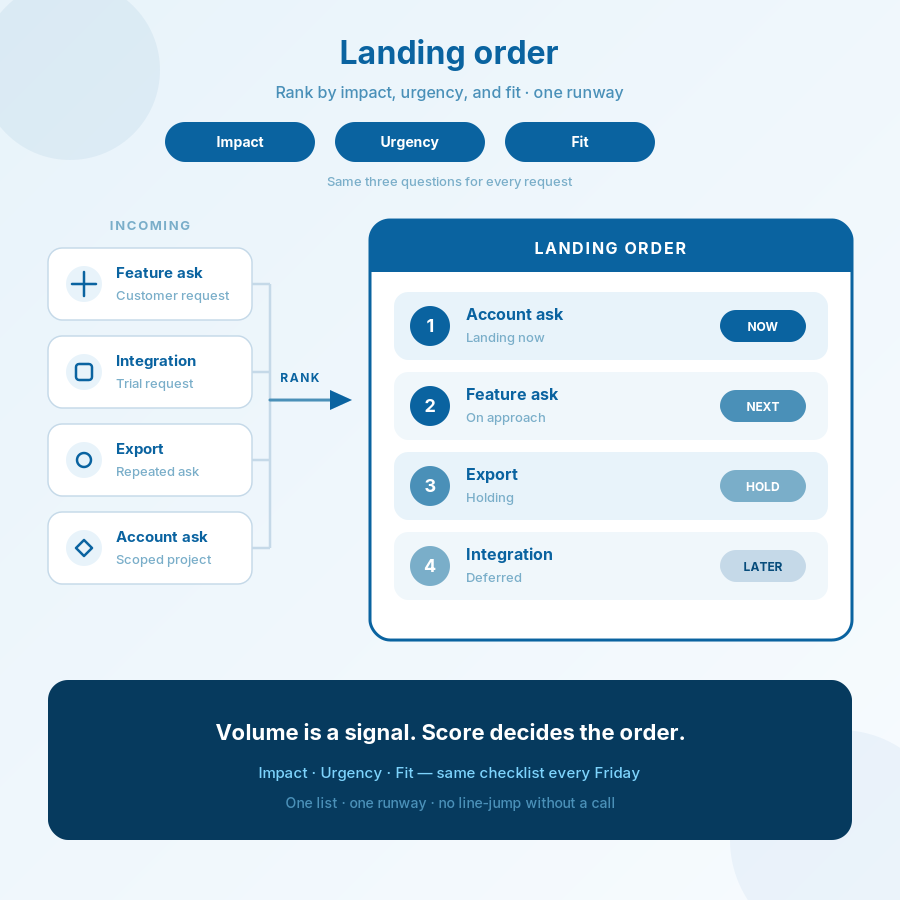
Volume is not on the list. Ten small accounts asking for dark mode might score lower than one account asking for an SSO fix that's blocking a $40,000 renewal. Count the asks as a signal, but rank on the score.
Rescore every Friday. A request that was a 4 in September can be an 8 once a renewal date gets close.
4. Radio Discipline: Tell Customers Where They Stand
Pilots in a holding pattern stay calm because the tower tells them where they are in line. Customers are the same. Most customer frustration comes from silence, not from a "no."
When a request comes in, reply within a day with one of three answers: it's scheduled, with a rough date; it's on the list and you'll review it on a set date; or it's not something you're building. For example: "We logged this today. We review requests every Friday, and I'll tell you by November 13 whether it makes the next cycle."
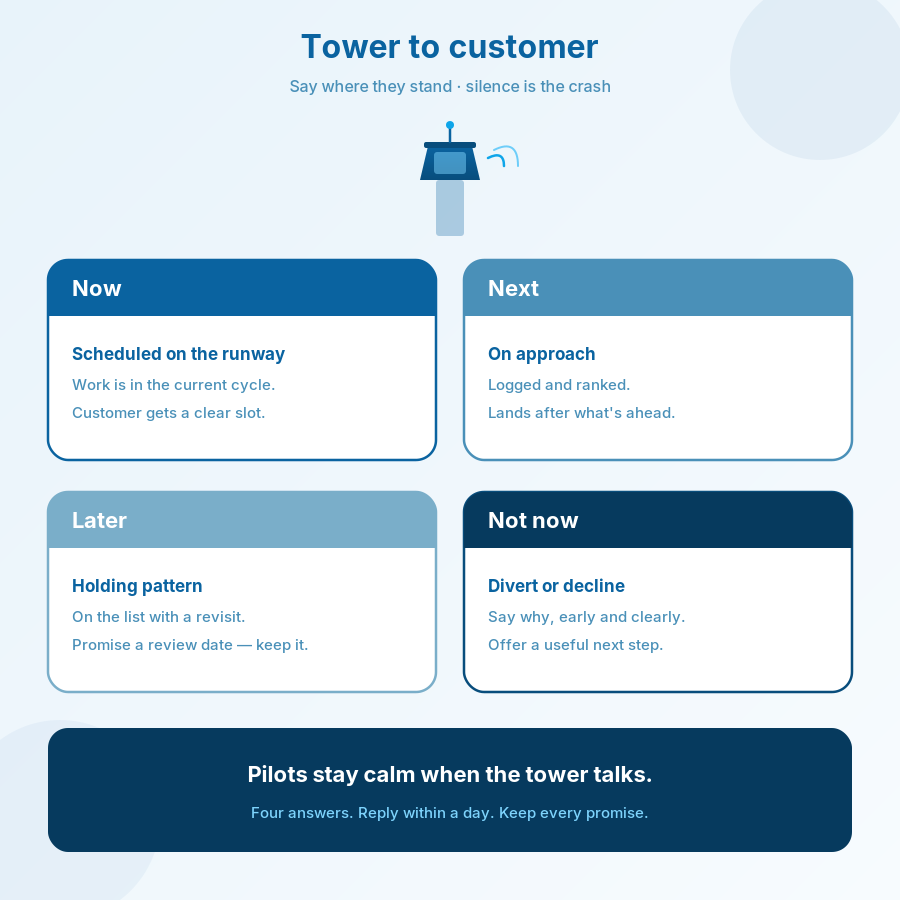
Then keep the promise. If November 13 comes and you haven't decided, say so. A short "still deciding, new date is the 20th" keeps the trust. Saying nothing burns it.
5. Closing the Airport: Saying No or Not Now
Some planes have to divert. A request can be reasonable and still not belong in your product.
Say no early and say why. "We're focused on reporting for the next two quarters, so we won't build the calendar sync. Here's the tool two of our customers use for it." That reply turns a dead end into something useful, and the customer leaves the conversation with a next step instead of a shrug.
"Not now" is a real answer too, as long as it comes with a date to revisit. Put that date on the list so it doesn't quietly turn into "never."
You can't land every plane. You can know which ones are in the air, how much runway you have, and which one comes down next.
Start this week: put every open request on one list, write your real hours at the top, and give each customer a date.
30th October 2026