


A small team stays steadier when a few boring habits still happen in a bad week. Founders running teams of one to ten who rewrite the plan after every high or low should put those habits in place before the next swing.
Say a four-person team lost a deal on a Monday that would have doubled the quarter. By Wednesday the roadmap had been torn up for a new enterprise feature the lost account had asked for. Two weeks later a surprisingly large inbound deal arrived, and the roadmap was torn up again, this time for a self-serve signup the new prospect wanted. A month later, nothing had shipped. The team had been leaning with every gust.
Ships carry ballast low in the hull so a hard wind does not tip them. The useful version for a small team is three heavy, boring habits: a thirty-minute weekly review, a monthly runway number, and a one-line written decision log.
1. Notice When You're Tipping
The first sign is usually the roadmap. In the hypothetical above, one lost deal and one unexpected win were enough to rewrite the plan twice, and both rewrites started after a single call. If every promising conversation can reopen the quarter's work, the team is already tipping.
A common next sign is a skipped habit. You cancel Friday's review because a demo ran long, or you put off the cash number because the week felt busy. A decision made in the hallway and never written down will also tilt the team: two weeks later, people remember the call differently. None of this looks dramatic in the moment. A month of it looks like the team that shipped nothing.
2. Lay Down Three Pieces of Ballast
Start with three habits, and keep each one concrete.
The weekly review is thirty minutes, same time each week. What shipped. What's stuck. What you will do next week. That is the whole agenda. If the four-person team in the hypothetical had kept that review on the calendar after the lost deal, they might still have changed course, but they would have done it once, in writing.
The runway check is a monthly number: weeks of cash on hand at the current spend. Write it down, even when the number is comfortable. A team that only looks at cash after a shock is already leaning.
The decision log is one written line for each call that changes the work, plus a short why. "November 12: paused the iOS build because the Android waitlist is empty and we have eight weeks of runway." Keep it to a line you can reread when the next gust arrives.
3. Run the Heavy Week Test
Once the habits exist on paper, ask: if this week went badly, would these three still happen?
That is the Heavy Week test. Picture a week like the one in the hypothetical, with a lost deal on Monday and a messy rewrite tempting you by Wednesday. Would the thirty-minute review still get a slot? Would someone still write the runway number? Would the new direction still make it into the log as a one-line decision?
If any of the three would get skipped, it is not ballast yet. Shorten the habit until a bad week would still include it. A ten-minute review that happens is heavier than a two-hour retrospective you cancel.
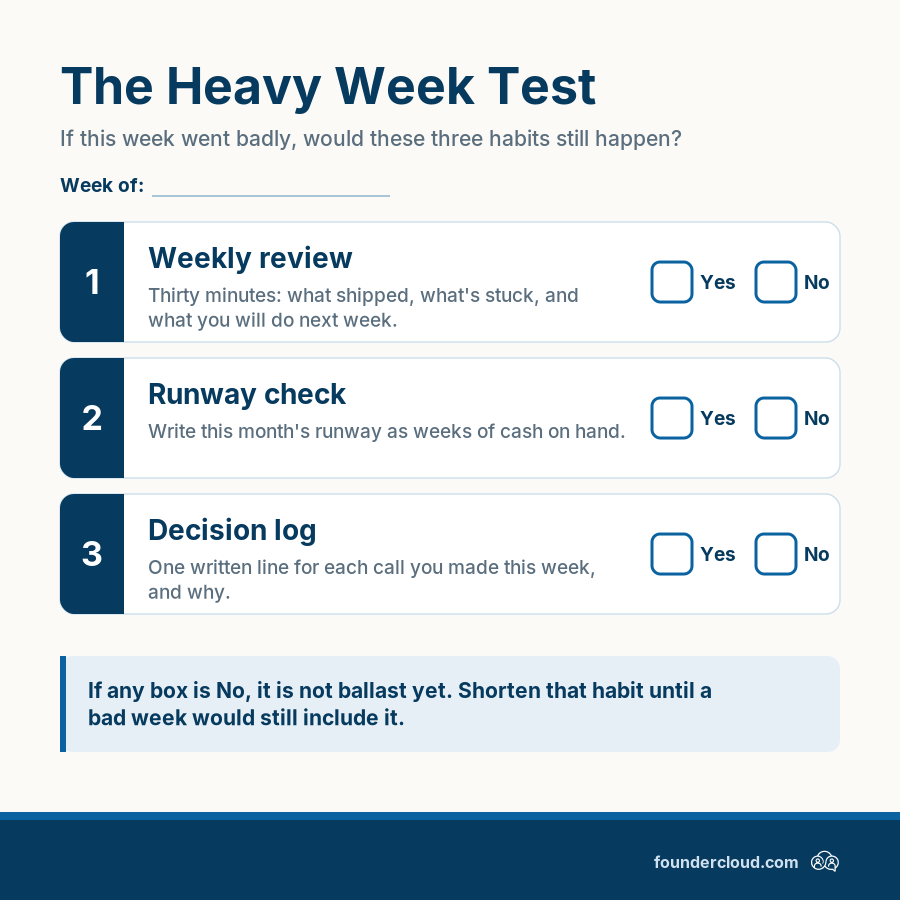
If a bad week would make you skip the weekly review, the runway check, or the decision log, shorten that habit until it would still happen.
4. Keep It Low and Boring
Ballast works because it sits low and does not ask for a ceremony. Keep the three habits under an hour a week in total. The monthly runway check might take ten minutes. The decision log is a line or two when you make a call. The weekly review is thirty minutes, and then you stop.
The miss on this side is turning the habit into a production. Say the same team decides the weekly review now needs a shared template that takes Friday afternoon to fill in, plus a ninety-minute meeting. In a hard week, that meeting will be the first thing they cancel, which is how they end up with no review at all.

Keep the weight low, where a hard week cannot tip it.
Leave the habits boring on purpose. If you want a second set of eyes on whether yours would survive a bad week, bring the Heavy Week results to the FounderCloud community.
This week, run the Heavy Week test on the habits you already have. If the review, the runway number, or the decision log would get skipped, shorten it until a bad week would still include it.
Pocket checklist:
- Watch for tipping: a roadmap that changes after every call, a review you cancel, a decision nobody wrote down.
- Put three habits on the calendar: a thirty-minute weekly review, a monthly runway number, and a one-line decision log.
- Run the Heavy Week test: if this week went badly, would all three still happen?
- If one would get skipped, cut it down until it would survive.
- Keep the three habits under an hour a week, and resist turning them into a meeting with a deck.
Do it before the next swing arrives.
19th November 2026