


Ten customers who would be upset if you vanished will teach you more than a thousand who could see themselves using the product someday. Early-stage founders still measuring progress in signups should count the people who would actually miss what they built.
Say a founder spent six months on a meeting scheduler, launched on a Tuesday, and hit 2,000 signups by Friday. The dashboard looked like a summit. Two weeks later, forty people had finished setup, and most of those had not come back. When the founder emailed the most active accounts to ask how they would feel if the tool disappeared, two said they would be very disappointed. The rest said they would be somewhat disappointed, or that they would go back to the calendar they already used. The launch produced a crowd in the parking lot, and almost no one who would notice if the tents came down.
Climbers do not start for the summit from the parking lot. They build a base camp first. Seth Godin made a similar point in "First, ten": begin with a handful of people who actually want the work.
1. Count the People Who Would Miss You
Signups are easy to celebrate and easy to misread. In the hypothetical above, 2,000 people raised a hand. Almost none of them had a reason to stay. The useful count is smaller: how many people would be genuinely upset if you shut the product down this Friday?
Be careful with polite interest. "I could see myself using this" is a compliment, and that is about all it is. A person who would miss you can tell you what they would lose, in their own words, and they already have a workaround they dislike.
If you cannot name ten such people today, you do not have a base camp yet. You have a launch.
2. Run the Would You Miss It Test
Ask your best ten users a question Sean Ellis used in his product-market-fit survey, later popularized by Rahul Vohra at Superhuman: how would you feel if you could no longer use this product? Give them three answers: very disappointed, somewhat disappointed, or not disappointed.
Then write down exactly what they would miss. "Very disappointed" with no specifics is still vague. "I would miss the way it turns a messy weekly schedule into one message I can send my team by Monday morning" is a job you can improve.
Who to ask: people who have used the product more than once, not the waitlist. If you only have six such people, ask those six. Do not pad the list with polite accounts to make the number look like ten.
Do not turn this into a precise score. You are listening for who would care, and for the work they would lose.
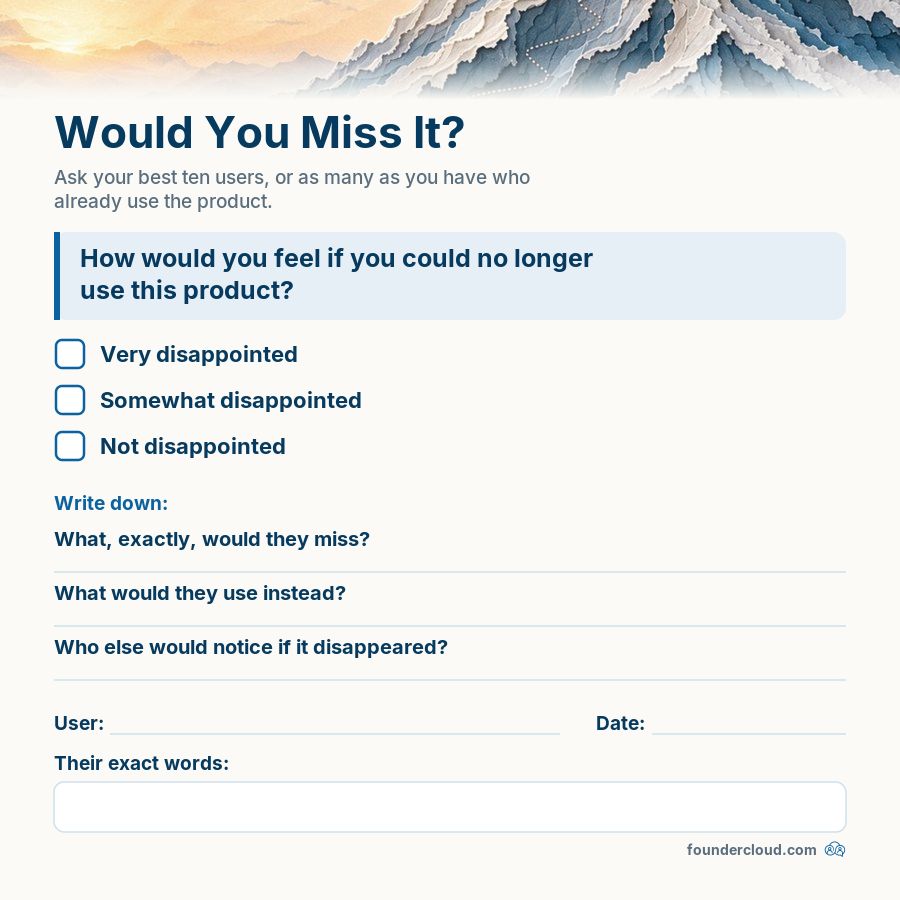
Ask your best ten users how they would feel if the product went away, then write down exactly what they would miss.
3. Build for the Ten
Serve them by hand if you have to. Fix what they would miss first. If someone who is only somewhat disappointed asks for a new integration, write it down and leave it for later.
In our hypothetical, the two people who would be very disappointed both cared about one thing: getting a clean agenda to a client before a call. That is the work to improve this month, even if twenty other signups asked for calendar colors and a mobile redesign.
This will feel slow. It is supposed to. Base camp is built by hand so the later climb has somewhere to stand.
4. Let the Ten Pull You Up the Mountain
Once those ten are being served, let them help you find the next stretch. Ask who else has the same problem. Write down the words they use for the job, and put those words on the homepage instead of the language you invented for the launch. The next ten should look like the first ten.

A ledge camp at the base, and a switchback trail climbing to the summit.
A referral from someone who would miss you arrives with a job already in mind. In the scheduler example, they are trying to get that agenda out before a client call, not browsing a launch thread.
If you want a second set of eyes on who you are counting as your ten, share the list in the FounderCloud community.
This week, pick your ten best users, or as many as you actually have, and run the Would You Miss It test. Write down their answers in their words.
Pocket checklist:
- Name up to ten people who already use the product more than once.
- Ask how they would feel if it went away, and what they would miss.
- Treat only the "very disappointed" answers as your base camp.
- Fix what those people would miss before you take feature requests from the rest.
- Use their words on the homepage, and ask them who else has the same job.
Do it before you plan the next launch.
13th November 2026