


How to Split Equity With a Co-Founder Without Destroying the Company
Picture this: It is two years into your startup’s journey. You have spent eighty hours a week building the core technology, securing your first $500,000 in ARR, and pitching venture capitalists. Your co-founder, who initially came on as the business lead, has steadily scaled back their hours to twenty per week, taken a part-time consulting gig on the side, and missed three consecutive board updates.
Yet, when you check your cap table, they own 50% of the company.
Every dollar of value created by your late-night engineering sprints is being split down the middle with someone who mentally checked out twelve months ago. Resentment brews. Product velocity grinds to a halt. Investors take one look at your cap table, see an unmotivated, inactive shareholder holding half the voting power, and pass on your Series A.
This isn't a hypothetical nightmare. Co-founder equity disputes are consistently ranked among the top three causes of early-stage startup failure.
Most founders treat the equity conversation like an uncomfortable bar tab—split it 50/50 right away just to avoid awkwardness. But equity is not a trophy awarded for past friendship or initial brainstorms. Equity is a forward-looking incentive engine designed to align a team over a 7- to 10-year marathon.
This guide is the definitive playbook for structuring your co-founder equity split. We will cover why 50/50 is often a trap, how to value early contributions accurately, dynamic vs. fixed models, non-negotiable vesting terms, and the exact word-for-word scripts to navigate this conversation smoothly.
1. The Deadly Allure of the Equal 50/50 Split
When Y Combinator surveyed hundreds of startup applications, they found that over 70% of co-founder teams chose an exact equal split.
Why is 50/50 so overwhelmingly popular? Because it is cognitively cheap. It avoids conflict, signals mutual trust, and allows the founders to get back to building.
However, an equal split made on Day 1 is almost always a symptom of deferred decision-making.
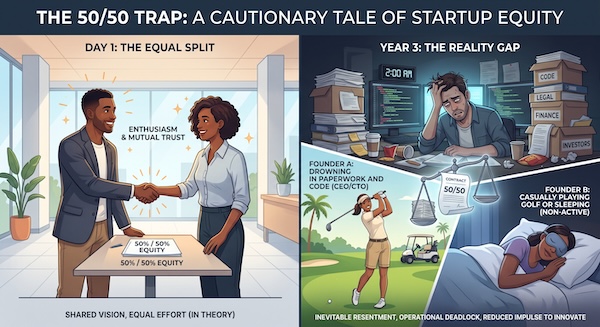
The Three Structural Flaws of 50/50
Equal Equity Rarely Equals Equal Contribution Over 10 Years: On Day 1, two founders might feel equally committed. But three years in, Founder A may be putting in 80 hours a week as CEO, raising funds, and taking on personal guarantees, while Founder B’s role has stabilized into a standard 40-hour engineering manager function. An equal split fails to compensate for asymmetrical long-term risk and responsibility.
The Governance and Deadlock Risk: If two founders own 50% each with voting stock and reach an impasse on a pivot, a key hire, or a buyout offer, the company is legally gridlocked. Neither can outvote the other. This stalemate can paralyze operations or lead to costly court-ordered dissolutions.
Institutional Investor Red Flags: Sophisticated venture capital firms scrutinize cap tables. If an investor sees two co-founders with a 50/50 split where one founder clearly drives 90% of the vision and GTM, they worry about two things: Is the primary value-driver adequately incentivized? Does the team lack the leadership maturity to make hard decisions and assign clear authority?
When IS a 50/50 Split Justified?
A 50/50 split is reasonable only when all of the following conditions are met:
Both founders start on the exact same day. Both founders quit their jobs simultaneously and go full-time together. Both take identical financial risk. Both possess complementary, equally critical domain skills. The team implements a formal tie-breaking mechanism.
If your situation does not match all five points above, a weighted, asymmetrical split is far healthier for the long-term survival of the business.
2. The Weighted Equity Matrix: Evaluating Real Contributions
Instead of pulling numbers out of thin air, top accelerators and venture studios use an objective weighted scoring model. Equity should reflect the relative value of five distinct contribution pillars over time.
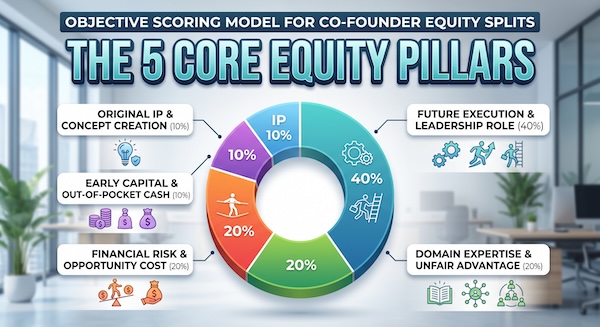
Pillar Breakdown
1. Future Execution & Leadership Role Ideas are cheap; execution is everything. The person taking on the CEO role typically absorbs the majority of external liability, fundraising burden, media scrutiny, and ultimate firing/hiring decisions.
2. Domain Expertise & Unfair Advantage Does one founder bring ten years of specialized industry relationships, proprietary algorithms, or regulatory clearances that shortcut years of development? Deep domain expertise that directly drives distribution or technical feasibility commands a higher share.
3. Financial Risk & Opportunity Cost Evaluate what each founder is sacrificing to be at the table. Founder A leaves a massive salary while Founder B joins straight out of college with lower personal overhead. Or Founder A goes full-time immediately with zero salary for 12 months, while Founder B stays part-time.
4. Financial Capital Contributions Direct cash invested into the bank account to fund early legal setup, server bills, or initial prototyping.
5. Original IP & Concept Creation Who came up with the original idea or built the initial prototype? While founders often overvalue the idea, it does carry legitimate early momentum value.
3. What to Do When One Co-Founder Starts Earlier
A common challenge occurs when Founder A works on a concept solo for six to twelve months before recruiting Founder B as a true co-founder.
Founder A naturally feels: I’ve already put in a year of blood, sweat, and tears. It’s unfair to give Founder B half.
Founder B naturally feels: If I am joining to build the next 10 years with you, I cannot feel like a hired employee. I need true co-founder equity.
Here are the three cleanest legal and financial mechanisms to solve this without destroying trust:
Option 1: The Head-Start Equity Premium Founder A receives an outright bonus percentage off the top to recognize prior IP and progress. The remaining percentage is then divided based on forward-looking expectations.
Option 2: Convertible Debt or Deferred Cash Repayment If Founder A spent their personal savings on legal fees, servers, and contractors before Founder B arrived, do not distort the permanent ownership structure. Instead, record the money as a Founder Loan or Convertible Note.
Option 3: Asymmetrical Vesting Credit If Founder A has worked full-time for 12 months before Founder B joins, both founders can agree to an identical total stock count, but Founder A gets 1 year of vesting credit applied immediately.
4. Fixed Splits vs. Dynamic Splits (Slicing Pie)
When splitting equity early, founders must decide between two fundamental philosophies: Fixed Equity Splits and Dynamic Equity Splits.
The Fixed Split Model
In a fixed model, the founders agree on static percentages on Day 1. Unvested shares are protected through a 4-year vesting schedule with a 1-year cliff.
The Dynamic Split Model
In a dynamic model, no fixed percentages are locked on Day 1. Instead, equity is treated as a rolling calculation based on daily or monthly inputs like hours contributed, cash invested, and non-cash assets.
If you are building a venture-backed startup with full-time co-founders, use a Fixed Split with strict 4-year reverse vesting. If you are bootstrapping part-time with fluctuating hours and unproven commitments, a Dynamic Split provides an elegant safety net until the business model stabilizes.
5. The Non-Negotiable Guardrails: Vesting, Cliffs, and Acceleration
Rule number one of Startup Law: Never, under any circumstances, issue 100% upfront vested stock to a co-founder—no matter how close you are, how long you’ve known each other, or how much you trust them.
What is Reverse Vesting?
When stock is issued, the founders own the shares immediately for voting purposes, but the company retains the legal right to repurchase unvested shares at par value if the founder leaves or is terminated.
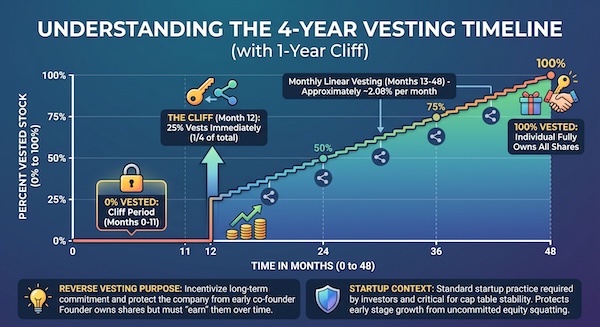
The 1-Year Cliff: No equity vests during the first 12 months. If a co-founder leaves or is fired on Day 364, they exit with 0% equity. On Day 365, exactly 25% of their total equity vests in a single lump sum.
Monthly Vesting Post-Cliff: After the 12-month cliff, the remaining 75% vests in equal monthly increments over the next 36 months.
Acceleration Clauses: Single-Trigger vs. Double-Trigger
What happens to unvested founder equity if the startup is acquired before the 4-year vesting schedule completes? This is governed by Acceleration Provisions.
Single-Trigger Acceleration (Avoid) Unvested shares automatically vest 100% immediately upon a change of control. Acquirers hate this because founders have no incentive to stay post-acquisition.
Double-Trigger Acceleration (Industry Standard) Unvested shares accelerate if and only if two distinct events occur: The company is acquired, AND within 12 months of the acquisition, the founder is terminated without cause or forced out due to a material reduction in responsibility.
Bad Leaver vs. Good Leaver Provisions
What happens to equity when a founder leaves? Sophisticated operating agreements distinguish between how a co-founder exits.
Good Leaver A "Good Leaver" is typically a founder who departs the company on amicable terms or due to circumstances beyond their control.
Common Scenarios:
- Health crisis or severe disability.
- Family emergency.
- Mutual agreement with the board/other founders to step down.
- Standard resignation without malice or breach of contract.
Equity Treatment:
Vested Shares: The founder retains 100% of their fully vested shares. Unvested Shares: Any unvested shares are automatically cancelled or repurchased by the company at par value (e.g., $0.0001 per share).
Bad Leaver A "Bad Leaver" is a founder who is terminated for cause or leaves the company under damaging or negligent circumstances.
Common Scenarios:
- Fraud, embezzlement, or severe financial misconduct.
- Gross negligence or willful breach of fiduciary duty.
- Criminal activity or conviction of a felony.
- Theft of intellectual property or violating a non-compete/non-disclosure agreement.
Equity Treatment:
Vested & Unvested Shares: The company retains the punitive right to repurchase both vested and unvested shares at their original cost or fair market value, effectively stripping the founder of their ownership stake due to their harmful actions.
6. The 83(b) Election: The $100,000 Tax Trap
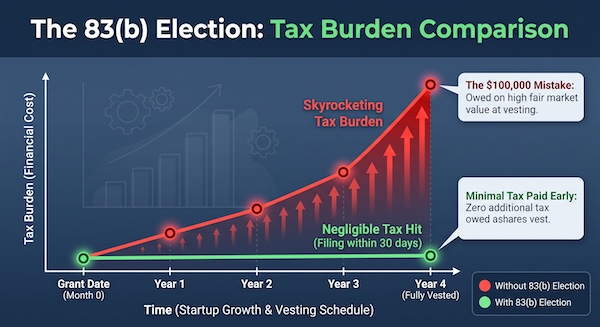
Failing to file an 83(b) election within 30 days of receiving restricted stock is one of the single most expensive legal mistakes an early-stage founder can make.
How the 83(b) Tax Trap Works When you incorporate and issue restricted stock subject to vesting, the IRS treats unvested stock as income as it vests over time.
Without an 83(b) election, you could owe hundreds of thousands of dollars in income taxes on illiquid paper stock as it vests at a higher valuation. By filing the election, you explicitly tell the IRS to tax you on the total value of all your shares today, rather than as they vest.
7. Word-for-Word Conversation Scripts for Founders
Having the equity conversation can feel uncomfortable. The key is to frame the discussion not as a zero-sum negotiation, but as a joint stress-testing exercise for the long-term health of the business.
Script 1: How to Suggest an Asymmetrical Split "Hey Name, I want to set aside an hour this week for us to align on our long-term cap table and equity structure before we finalize our legal incorporation. I want to make sure we set this up right for the 10-year marathon ahead. Defaulting to 50/50 is easy on Day 1, but every startup advisor and VC I’ve spoken with emphasizes that equity should reflect long-term operational responsibility, financial risk, and leadership accountability. Let’s walk through a weighted contribution matrix together and see where our numbers land."
Script 2: How to Introduce Vesting & Cliffs Without Sounding Distrustful "I trust you completely—that’s why I’m building this company with you. But vesting isn’t about a lack of trust between us; it’s our mutual protection plan against life’s black swan events. If either of us has a family emergency, a health issue, or realizes 18 months in that our life priorities have changed, it would be devastating for the company if the person who leaves walks away with half the startup’s ownership permanently. Standard 4-year vesting with a 1-year cliff protects both of us."
Script 3: How to Address a Co-Founder Going Part-Time "Because full-time cash sacrifice and operational speed are huge risk factors right now, it wouldn't be fair or sustainable for our cap table to reflect equal ownership while our time and financial inputs are asymmetrical. Here is what I propose: We baseline our split at 65/35 today to reflect the full-time vs. part-time risk differential. Once you transition to 100% full-time, your vesting rate accelerates to close that gap based on future contribution."
8. The Co-Founder Equity Term Sheet Checklist
Stay tuned for our upcoming post where we will share the complete Co-Founder Equity Term Sheet Checklist!
Conclusion: Equity is a Tool, Not a Trophy
Splitting equity with a co-founder is one of the first true stress tests of your business partnership.
If you avoid hard conversations, default to a lazy 50/50 split, and skip vesting schedules out of misplaced politeness, you are building your startup on a fragile foundation.
Take the time to evaluate real contributions, establish firm reverse vesting guardrails, file your 83(b) elections, and document every agreement legally. Treat your cap table with the respect it deserves—because the decisions you make in your startup's first 30 days will dictate its trajectory for the next 10 years.
15th August 2026