


Seconds are the honest signal, because a first plate is often just politeness. Founders of teams of one to ten whose early users try the product once and then drift off should count the people who come back for another helping.
Say a three-person team launched a freelance proposal tool on a Tuesday and hit 420 signups by Friday. The dashboard looked like a packed table. They spent the next month chasing another launch post, and another spike of first-time signups. Almost nobody came back to write a second proposal. The polite notes said "looks great!" and hid how few people returned for more.
At a holiday table, almost everyone takes a first plate to be polite, and a signup works the same way. The test still holds in January.
1. Count the Second Plates
Signups are easy to celebrate and easy to misread. In the hypothetical above, 420 people took a first plate. The number that matters is how many came back on their own for a second session.
What counts as a second plate depends on the product. It might be a return visit, a second project, or an invite. For the proposal tool, the useful count was people who came back and started a second proposal, without a nudge from the team.
Be careful with polite praise. "Looks great!" is what guests say when they want to be kind, and in the hypothetical, those notes kept arriving while the second-session count stayed almost flat.
If almost nobody comes back, pouring more first plates will not fill the table. Look at the second-session count before you plan the next launch.
2. Run the Would They Ask for Seconds? Test
Take your last ten signups, or as many as you have. For each person, ask three questions.
Did they come back on their own without a nudge?
Did they bring more of their own work or data?
Did they ask for something: a feature, an invite, or a price?
Two or more yeses means they want seconds. Zero or one is a polite first plate.
That is the Would They Ask for Seconds? test.
In the hypothetical, the team ran it on the last ten signups from the launch week. Eight never came back after the first proposal. One came back only after a reminder email, which is a nudge, so the first question is a no. One came back on their own, added a second client's details, and asked whether they could invite a collaborator. That person scored three and wants seconds. The other nine were first plates.
Do not pad the list with accounts you already know are fans. If you only have six recent signups, score those six.
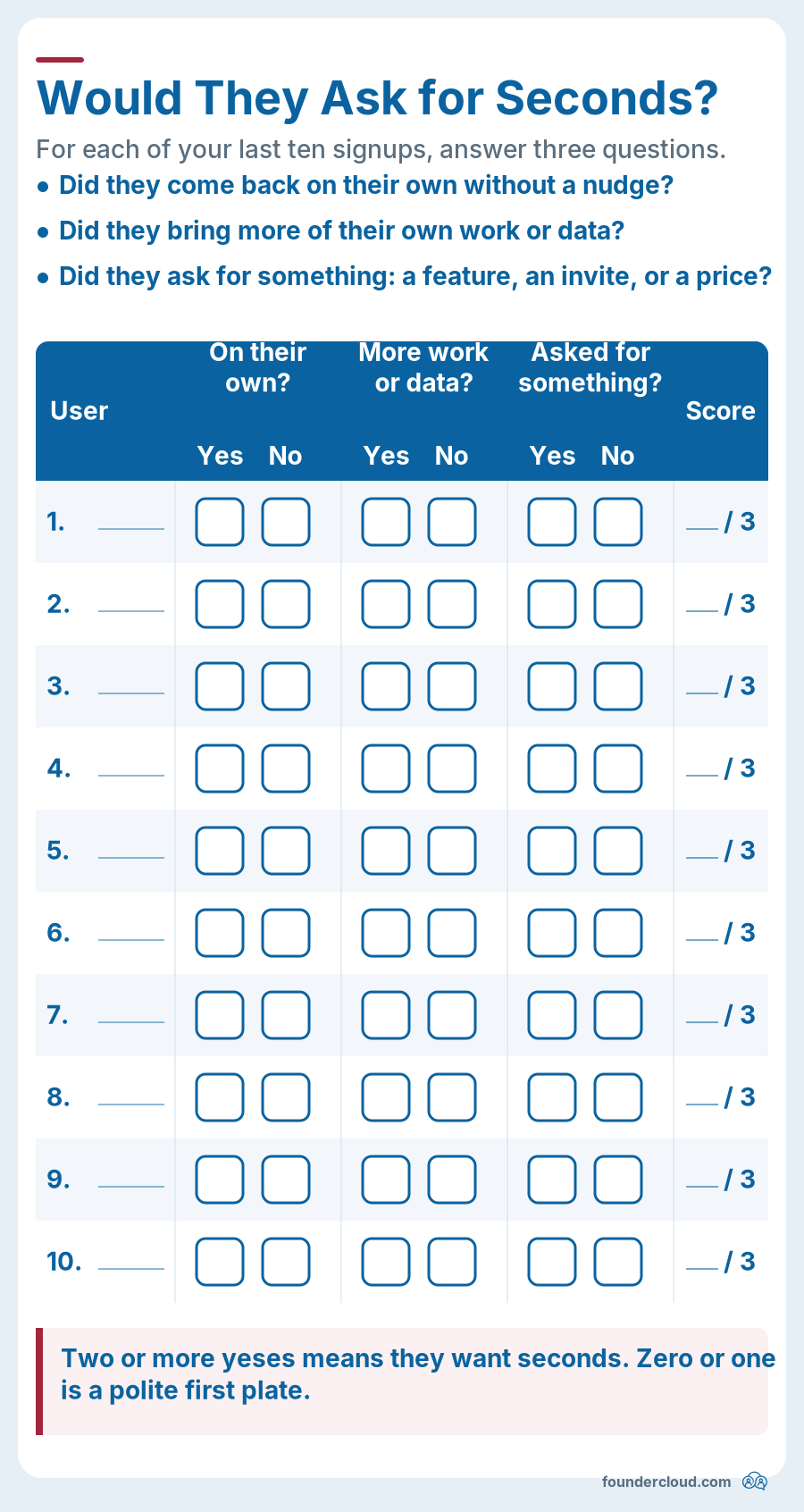
Score your last ten signups. Two or more yeses means they want seconds. Zero or one is a polite first plate.
3. Make the Second Helping Easy
Once you know who came back, look at what was waiting for them.
In the proposal tool example, a user who returned found a blank dashboard. The first proposal was saved, but it sat two clicks out of sight, and nothing on the screen suggested starting the next one for a different client. Coming back felt like sitting down to an empty table.
Leave their work where they can see it. Put a next step on the same screen, such as starting the next proposal or inviting the person they work with. Give them a reason to return this week, even if it is only a draft that is still open.
The miss is spending the month on a prettier first-run tour while the return visit is empty. In the hypothetical, a smoother welcome flow would have produced more polite first plates. It would not have helped the person who wanted to write a second proposal.

Leave something waiting for them when they come back.
4. Ask the People Who Came Back
Ask the people who wanted seconds what brought them back, and cook more of that.
In the hypothetical, the one person who scored three came back because they had a second client and needed a second proposal in the same format as the first. That is the dish to make more of. The "looks great!" notes asked for fancier templates. Those are first-plate compliments. Follow the person who came back.
A short note is enough: what made you return, and what were you trying to finish? Write down their words. If two people mention the same job, that job is your next week of work.
If you want a second set of eyes on who is asking for seconds, bring the worksheet to the FounderCloud community.
This week, take your last ten signups and run the Would They Ask for Seconds? test. Then make the return easier for anyone who already came back, and ask them what brought them.
Pocket checklist:
- Count who came back for a second helping.
- Run the Would They Ask for Seconds? test on your last ten signups.
- Two or more yeses means they want seconds. Zero or one is a polite first plate.
- When they return, have their work waiting, and a clear next step.
- Ask the people who came back what brought them, and do more of that.
Do it before you plan the next launch.
26th November 2026