


Startup Things: Vol 2 | The Shadow Monster
Congratulations. You survived Volume 1. You found the signal in the static, you identified your "Eleven" superpower, and you escaped the Demogorgon of market indifference. You have revenue. You have users. You probably just closed a celebratory round of funding.
Welcome to Hawkins, Season 2. On the surface, everything seems better. The lights aren't flickering anymore. The kids are hanging out at the arcade, pumping quarters into Dragon's Lair. Life has returned to a semblance of normalcy.
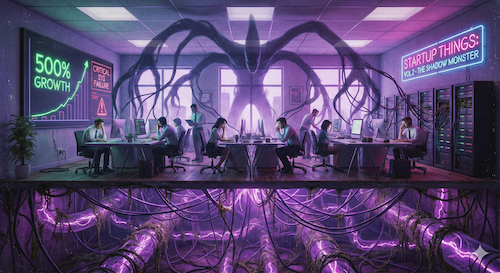
But Will Byers knows the truth. He keeps having "episodes"—flashes where the sunny world is replaced by a dark, stormy sky dominated by a massive, arachnid shadow monster. Nobody else can see it yet, but Will knows it’s growing, and it’s connected to everything.
Welcome to the Hyper-Growth stage of your startup.
If Volume 1 was about the fear of failure, Volume 2 is about the terror of success. You are now growing faster than your infrastructure—both technical and human—can handle. The surface metrics look fantastic, but underneath the floorboards, a network of toxic vines is spreading, threatening to rot the foundation of everything you’ve built.
It’s time to face the Shadow Monster.
I. The View from the Arcade (The Illusion of Health)
The most dangerous phase of a startup is immediately after finding Product-Market Fit. Why? Because everyone relaxes. Investors are happy with the MRR graph. The press wants to interview you. You feel like the kings of the arcade, racking up high scores.
But as a founder, you start having those "Will Byers episodes."
You’re in an all-hands meeting, celebrating a huge sales quarter, but suddenly you flash to the reality: customer support tickets are up 400%, the engineering team is pulling all-nighters to patch critical bugs, and your new hires don't even know the company mission statement.
You snap back to reality. Everyone is clapping. But you’ve seen the sky turn purple.
This is the Shadow Monster of hyper-growth. It is the looming, oppressive pressure to maintain impossible velocity even though you know the engine is redlining. It’s the feeling that you are no longer driving the car; the car is driving you, and it’s headed off a cliff. The mistake many founders make here is ignoring these visions, writing them off as "imposter syndrome" rather than what they actually are: accurate pattern recognition.
II. The Tunnels Beneath Hawkins (Technical & Organizational Debt)
In Season 2, Chief Hopper digs a hole in a pumpkin patch and drops into a massive, slimy network of tunnels spreading beneath the entire town. The vines are pumping poison into the soil, killing the crops.
In Volume 1, you adopt a "move fast and break things" mentality. It’s necessary for survival. You write hacky code. You make handshake deals. You hire your cousin to do accounting. That’s fine when you have 100 users.
But now you have 100,000 users. That hacky code is now a subterranean tunnel network of technical debt. The handshake deals are legal liabilities. Your cousin is overwhelmed and making critical financial errors.
Founder Takeaway: Growth hides rot. When revenue is flowing, it’s easy to ignore inefficiencies. But hyper-growth acts as a magnifying glass for microscopic cracks in your foundation. If you don't stop digging holes and start mapping these tunnels, the ground will collapse under your feet. You have to shift focus from solely "shipping new features" to "paying down the debt" you accrued in Vol 1.
III. The Hive Mind Infection (Cultural Dilution)
The scariest thing about the Shadow Monster (the Mind Flayer) isn't its size; it’s that it operates as a hive mind. It infects a host, and that host becomes an extension of its will.
When you go from 10 employees to 100 in a year, you face a similar infection. The tight-knit "D&D Party" culture you built in the basement disappears.
Suddenly, you have departments that don't talk to each other. Marketing promises features that Engineering hasn't even scoped. Sales is closing deals that Customer Success can't support. New hires are operating based on their last company’s culture, not yours.
Your startup begins to operate like the possessed citizens of Hawkins—moving with a singular, destructive purpose (growth at all costs), but disconnected from the humanity and original mission of the founders. The culture becomes toxic, siloed, and reactive rather than proactive.
IV. The Bob Newby Tragedy (Ignoring Infrastructure)
We have to talk about Bob Newby, the superhero.
Bob was the smart, practical guy who figured out the map of the tunnels. He was helpful. He was brave. And he got eaten by Demodogs right before escaping the lab.
Why? Because he was a brilliant individual trying to solve a systemic failure with heroic effort.
In the hyper-growth phase, many startups rely on "Bob Newbys." These are your 10x engineers, your rockstar salespeople, or your tireless operations managers who work 80 hours a week to manually patch over the gaping holes in your processes. They are heroes.
And if you keep relying on them, you will kill them.
They will burn out, quit, or make a catastrophic error because they are exhausted. Relying on individual heroism is not a strategy for scale; it is a recipe for tragedy.
You need boring infrastructure. You need standard operating procedures. You need scalable technology stacks that don't require a Bob Newby to reboot the servers at 3 AM. You have to build systems that allow average performers to do good work, rather than requiring superstars to do impossible work just to keep the lights on.
V. Burning the Hub
To stop the vines in Season 2, they have to set fire to the central hub. It’s incredibly painful for Will, who is connected to the hive mind. He screams in agony as the heat is applied.
Fixing the problems of Volume 2 is going to hurt.
It means firing the toxic high-performer who is hitting their numbers but destroying the culture.
It means telling investors you are missing your quarterly product goals because you have to spend three months refactoring the database.
It means slowing down hiring to ensure proper onboarding.
It feels like you are burning your own company. But you are only burning out the infection so the host body can survive. If you don't apply the heat now, the Shadow Monster wins.
Coming Up in Vol 3...
You’ve mapped the tunnels. You’ve started paying down the debt. You are surviving the growing pains.
But Hawkins is changing. It’s the summer of 1985. The small-town vibe is gone, replaced by neon lights, consumerism, and a massive new structure that changes the landscape forever.
In Vol 3, we’re going to the mall. We’ll explore what happens when your scrappy startup is no longer flying under the radar, and a flashy, well-funded "Goliath" moves into your territory to crush you.
Welcome to the Starcourt Siege.
31st December 2025