


The 36-Month Pop-Up: Why You Should Build "Disposable" Startups
Every startup founder lives in terror of "The Update." You wake up, check X, and see that OpenAI, Anthropic, or Apple just released a native OS feature that completely replicates your entire product.
Overnight, your startup is dead. Your codebase is obsolete. Your investors are panicking.
For the last three years, the tech ecosystem has viewed this as the ultimate tragedy. We have been desperately trying to build "future-proof" AI companies—massive, defensible software cathedrals designed to last for a decade.
But what if the short lifespan of an AI startup isn't a failure state? What if it is the ultimate untapped business model?
Welcome to the era of the Arbitrage Startup. It’s time to stop building software cathedrals, and start building software scaffolding.
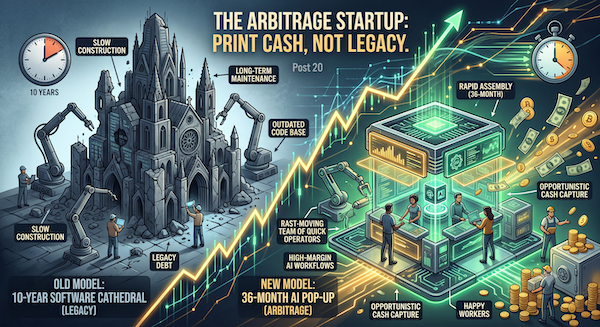
1. The Cathedral vs. The Pop-Up Shop
In the traditional SaaS era, you built a cathedral. Think of Salesforce or Workday. You spent two years and $10 million just pouring the foundation. You expected to spend the next ten years slowly acquiring enterprise logos, with the payout coming a decade later via an IPO or massive private equity buyout.
In the AI era, building a cathedral is financial suicide, because the tectonic plates of foundational models are shifting every six months. Your foundation will crack before you even finish the roof.
Instead, look at the retail industry. When a massive cultural trend hits, smart entrepreneurs don't sign a 10-year commercial lease to build a department store. They open a Pop-Up Shop. They secure a short-term lease, sell highly relevant, high-margin inventory, extract massive amounts of cash, and intentionally shut down the operation before the trend fades.
In 2026, we have a profound mismatch between the capability of AI and the adoption speed of legacy enterprises. LLMs are currently capable of automating massive, multi-million dollar inefficiencies in corporate America. But Fortune 500 companies are slow, bureaucratic, and terrified of data privacy. It will take them three to five years to natively integrate these capabilities into their internal systems.
That 36-month gap is your arbitrage opportunity.
2. The Playbook for the "Disposable" Startup
The Arbitrage Startup is a deliberate, highly tactical micro-monopoly designed to exploit this adoption gap. You know that the foundational models will eventually solve this problem by default, or that the enterprise will build it in-house. Your goal is not to survive until 2035. Your goal is to print cash for 36 months.
Here is the playbook:
Step 1: Identify an Acute, Expensive Bottleneck
Do not build a "nice-to-have" tool. Find a specific, manual process inside large companies that requires an army of BPOs (Business Process Outsourcers) or junior analysts. (e.g., Manually transferring medical records between incompatible hospital databases; migrating legacy COBOL code for a regional bank).
Step 2: Build Scaffolding, Not a Platform
Do not spend six months building a beautiful UI, a complex user permissions matrix, or a custom dashboard. The client doesn't want another login.
Use off-the-shelf, no-code orchestration tools to glue together current foundational models with the client's messy data. Your software is just temporary scaffolding that gets the data from Point A to Point B. The interface is just an email inbox or an automated report.
Step 3: Exploit the Bounty Economy
Because your lifespan is short, you cannot rely on a slow, $99/month SaaS accumulation model. You must use the Bounty Pricing model (as discussed in earlier posts).
Walk into the legacy enterprise and say: "You currently spend $2 million a year paying contractors to manually audit these supply chain invoices. I have an automated system that will do it right now. I will charge you $2 per audited invoice."
You don't sell them the software; you sell them the completed work. You capture the massive margin spread between the cost of an API token and the cost of human labor.
Step 4: Keep Headcount at Zero
The Arbitrage Startup must be lean. If you hire a massive engineering team, a sales fleet, and an HR department, you are acting like a Cathedral. By the time your team is fully operational, the 36-month window is closing.
You must act as a Sovereign Soloist or a tiny team of 2-3 Orchestrators. You use AI agents to write the code, run the outreach, and execute the service. Your margins should border on 95%.
Embrace the Sunset
The hardest part of the Arbitrage Startup is the psychology of the founder. You have to check your ego at the door.
You will not be on the cover of Forbes. You will not ring the bell at the NYSE.
But if you execute this correctly, in 36 months, when OpenAI releases GPT-6 and natively solves the problem your startup was built around, you won't be panicking. You will simply turn off the servers, thank the scaffolding for its service, and walk away with an incredible amount of liquid capital—ready to hunt for the next 36-month pop-up opportunity.
Stop trying to build a legacy. Build an ATM.
28th July 2026