

The AI Sharecropper: Why Your 80% SaaS Margins Are an Illusion
In the post-Civil War agricultural economy, millions of farmers fell into the trap of sharecropping. They did all the grueling, back-breaking labor of plowing the fields, planting the seeds, and harvesting the crops. But because they didn't own the land, the equipment, or the seeds, the landlord captured nearly all of the profit. The sharecropper was left with just enough to survive, locked in a cycle of dependency.
In 2026, Silicon Valley is witnessing the rise of a new, highly sophisticated form of digital serfdom: The AI Sharecropper.
Founders are pitching VCs with decks promising traditional SaaS gross margins of 80% or 90%. They are projecting massive profitability at scale. But these projections are a mathematical delusion.
If your core product is an AI workflow that relies entirely on sending millions of API calls to foundational models (like OpenAI, Anthropic, or Google) and renting H100 GPUs from AWS or Azure, you do not own your means of production.
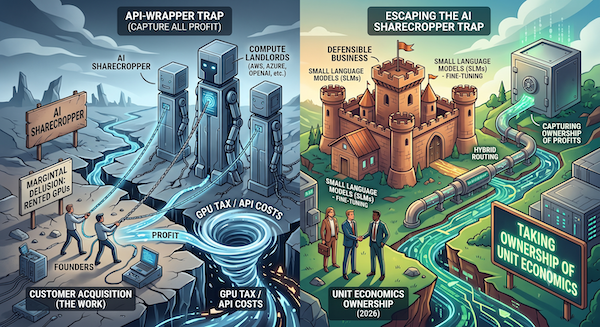
You are a sharecropper. You are doing the hard labor of acquiring the customer and building the UI, but the GPU Landlords are capturing the profit. And if you don't build an escape route, they will eventually bleed your startup dry.
1. The Death of the "Write Once, Sell Infinitely" Margin
To understand the Sharecropper Trap, you have to understand why traditional SaaS margins were so high in the first place.
In the 2010s, if you built a cloud-based project management tool, your primary expense was the fixed cost of human engineering (writing the code). Once the code was written, the variable cost of adding a new user was essentially zero. Serving a web page or a database query costs fractions of a penny. This is the "Write Once, Sell Infinitely" model that generated 85% gross margins and made VCs incredibly rich.
Generative AI fundamentally breaks this physics.
Every time a user asks your AI Agent to summarize a document, draft an email, or analyze a dataset, you are triggering a massive, computationally expensive event. You are paying a "Compute Tax" in the form of input and output tokens.
Traditional SaaS: User logs in 100 times a day -> Your server costs increase by $0.001. You make $99/month.
Agentic SaaS: User triggers your AI Agent 100 times a day to execute complex chain-of-thought workflows -> Your API costs increase by $15.00 a day. You lose money on the $99/month subscription.
In the AI era, your Cost of Goods Sold (COGS) scales linearly—and sometimes exponentially—with user engagement. The more your customers love and use your product, the closer you get to bankruptcy.
2. The API Wrapper Vulnerability
The most vulnerable sharecroppers are the "API Wrappers." These are startups that have built a beautiful user interface on top of a foundational model, but possess no proprietary model architecture or unique data pipelines.
If your entire value proposition is taking a user's input, injecting it into a clever system prompt, sending it to GPT-4, and formatting the output, you have zero leverage against the Landlord.
When OpenAI or Anthropic inevitably raises their API pricing for enterprise tiers, or when they release a native feature that mimics your UI, your business evaporates overnight. You are renting a thin slice of land on an active volcano.
3. The Landlord's Squeeze
The GPU Landlords (the hyperscalers and foundational model providers) are fully aware of this dynamic. They know that the application layer (your startup) is doing the expensive, messy work of finding Product-Market Fit, educating legacy enterprises, and handling customer support.
They are happy to let you be the vanguard. They will even give you $100,000 in free cloud credits to get you started.
But once you scale, the credits run out. The compute bills arrive. And because your users are now dependent on the specific intelligence of that foundational model, your switching costs are impossibly high. You can't easily swap the underlying brain of your product without breaking the user experience.
You are locked in. The Landlord can slowly turn the margin dial, extracting the value you created until you are left with just enough margin to keep the lights on.
4. Escaping the Farm: The Strategic Roadmap for 2026
If you want to build a sovereign, highly-valued AI company, you must aggressively build a roadmap to escape the sharecropper dynamic. You must transition from renting intelligence to owning it.
Step 1: The Hybrid Routing Architecture
You do not need a frontier model with 1 Trillion parameters to classify a customer support ticket or extract a date from an invoice.
Resilient startups use foundational models (the expensive land) only for the hardest, most complex reasoning tasks. They build intelligent routing layers that immediately direct 80% of routine user queries to smaller, vastly cheaper models.
Step 2: Fine-Tuning Small Language Models (SLMs)
The ultimate defense against the Compute Tax is the Small Language Model. As open-source models (like Llama 3 or Mistral) become incredibly capable, you must download them, host them on your own infrastructure, and fine-tune them on your proprietary customer data.
An SLM trained exclusively on your specific vertical (e.g., legal contract review) will routinely outperform a massive, generalist model at a fraction of the inference cost. When you host your own SLM, you own the land.
Step 3: Edge Compute and Local Inference
Push the compute cost back to the user whenever possible. If your product is a desktop application or mobile app, explore frameworks that run the AI models locally on the user's M-series Mac or neural processing unit (NPU). If the user's hardware is generating the tokens, your COGS drops to zero.
Own the Engine
The ZIRP era allowed founders to be financially lazy. We rented everything—servers, software, and eventually, intelligence.
But the 2026 market demands fundamental unit economics. If you are building an AI startup, your first question to your CTO shouldn't be "What prompt are we using?" It should be "What is our 12-month strategy to get off the API dependency?"
Do the hard work of building hybrid architectures, fine-tuning your own models, and capturing your own data. Stop working the Landlord's field, and build your own engine.
2nd July 2026