


The Bounty Hunter Economy: The Death of the $99/Month Subscription
If you hire a security guard to watch your warehouse, you pay them an hourly wage or a monthly salary. You are paying for their presence, their time, and their potential to stop a break-in.
But if a fugitive skips bail, you do not pay a bounty hunter an hourly wage to look for them. You pay a massive, flat fee the moment the fugitive is dropped at your feet. You are not paying for their time. You are paying exclusively for the outcome.
For the last twenty years, the B2B SaaS industry has operated like a security guard. We built software tools, handed them to human workers, and charged a flat $99 per user, per month for "access." We monetized the presence of the tool.
But as we enter the era of Agentic AI in 2026, the fundamental nature of software has changed. Software is no longer a tool that a human uses to do work; the software is the worker.
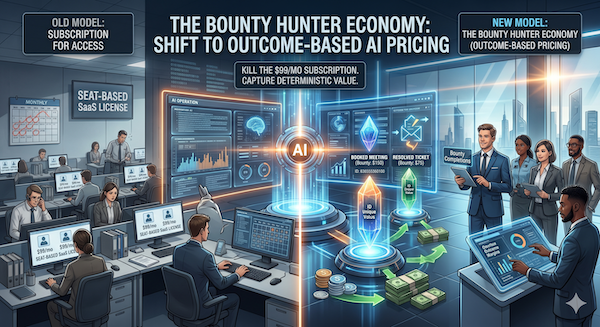
If you are still charging a flat monthly subscription fee for an autonomous agent, you are fundamentally mispricing your value. To survive the AI margin squeeze, founders must kill the seat-based license and embrace The Bounty Hunter Economy.
1. The Seat-Based Paradox
The $99/user/month pricing model is an artifact of a bygone era. It was a brilliant proxy for value when human labor was the engine of productivity. If a company hired 50 more salespeople, they needed 50 more Salesforce licenses. The software vendor's revenue scaled in perfect harmony with the customer's headcount.
AI shatters this alignment.
Imagine you build an autonomous AI sales agent that can scrape leads, personalize outreach, handle objections, and book qualified meetings on a calendar. A single "10x Orchestrator" at your client's company can manage a fleet of ten of these digital SDRs.
If you charge per seat, your client replaces a five-person marketing team (saving $400,000 in payroll) and pays you... $99 a month for the single human Orchestrator using your platform.
This is the Seat-Based Paradox: Your product just delivered 10x more value, and your revenue just dropped by 90%. You have successfully subsidized your customer's massive efficiency gains by destroying your own business model.
2. Selling Work, Not Software
To escape the paradox, founders must execute a radical pivot: Stop selling software and start selling work.
You are no longer a SaaS vendor providing a dashboard. You are an autonomous digital agency providing a completed task.
In the Bounty Hunter Economy, you charge for the deterministic outcome.
You do not charge $200/month for "AI contract analysis software." You charge $15 per reconciled contract.
You do not charge $500/month for an "AI lead generation platform." You charge $400 for every qualified meeting booked on the calendar.
You do not charge $50/month for an "AI customer support copilot." You charge $2 for every support ticket autonomously resolved without human intervention.
When you price for the bounty, your revenue scales with the value delivered, not the humans employed. If your AI works harder and closes more deals, you get paid more.
3. The Psychology of the Bounty
Transitioning to outcome-based pricing completely rewrites the sales psychology between you and the Enterprise buyer.
When you sell a $99/month subscription, you are pulling from the client's Software Budget. Software budgets are tightly guarded, heavily scrutinized by the CFO, and currently being slashed across the board as companies consolidate their tech stacks.
When you sell a $400 bounty for a booked meeting, you are pulling from the client's Payroll & Acquisition Budget.
You are no longer comparing your price to other software tools; you are comparing your price to the fully-loaded cost of a human employee. If a human SDR costs $80,000 a year to book 150 meetings, their Cost Per Meeting is over $500. When you walk into the room offering to book those same meetings for $400 a piece, the CFO doesn't see a software expense. They see an instant, scalable margin improvement.
Bounty pricing removes the friction of adoption because it completely eliminates the customer's risk. If your AI fails to deliver the outcome, they don't pay. You have aligned your incentives perfectly.
4. The Operational Reality: Becoming an Agency
Pivoting to the Bounty model sounds incredibly lucrative, but it requires a fundamental rewiring of your startup's operations.
When you charge a flat subscription, the burden of success is on the user. If they buy your CRM and never log in, you still collect the $99.
When you charge a bounty, the burden of success is entirely on you. If your AI agent fails to book the meeting, you burn compute costs (paying OpenAI or Anthropic API fees) and generate zero revenue.
To survive in the Bounty Hunter Economy, your engineering team must act less like feature-builders and more like industrial engineers optimizing a factory floor:
Relentless Margin Tracking: You must track the exact compute cost of every single outcome. If it costs you $8 in LLM tokens to negotiate and resolve a $10 support ticket, your gross margin is dangerously thin.
Deterministic Guardrails: You cannot let your AI Agents hallucinate or get stuck in infinite loops, because every loop costs you money. You must build robust "Circuit Breakers" (as discussed in previous posts) to kill failing agents before they drain your margins.
The "Human-in-the-Loop" Arbitrage: The most profitable Bounty startups in 2026 are not 100% autonomous. They use AI for 95% of the work, and pay a human contractor in a lower-cost geography to QA the final 5% before delivering the "Bounty" to the client. The client gets a perfect outcome, and you protect your brand.
Conclusion: Capture Your Value
The zero-interest-rate era trained founders to give away the farm in exchange for user growth. We subsidized our software to acquire logos.
In 2026, cash flow is king. If you have built an autonomous system capable of executing complex human labor, do not wrap it in a cheap subscription tier.
You built the machine. You took the risk. Now, claim the bounty.
29th June 2026