


The Dispatch Desk: Who Owns the Agents Once Everyone Needs Them?
If you're a founder running AI agents across more than one part of your startup, this one is for you. If your agents only do one job for one person, you can skip it for now.
It's 11:47 p.m. Two founders are in the same Slack thread. A customer wants a custom report by 9 a.m. Sales wants the agent to warm twenty leads before a 10 a.m. demo. Engineering wants it to finish the migration script that has been "almost done" since Friday. Nobody has decided which comes first, so the agent sits idle while three people argue about it.
That's where a lot of small teams are right now. We spent the last year learning how to build agents. Very few teams spent even a week deciding who runs them. The agents have quietly become shared infrastructure, like the database or the support inbox, and shared infrastructure needs an owner.
1. Name One Person Who Decides
Most early teams treat agents like the office printer. Anyone can grab one, anyone can redirect one, and nobody answers for it when it stalls halfway through two jobs.
That's fine for a weekend prototype. It breaks the first week you have a paying customer and two teammates with a "quick ask." Picture the support lead pulling the agent off a customer report at 4 p.m. to summarize call notes. Nobody tells the customer, and the report misses its deadline.
Ownership here means one named person who can say yes, no, or later. They don't write every prompt. They do control what the agent works on next, the same way a good operations lead controls a shared calendar. Whose card pays the API bill doesn't matter. What matters is who decides what runs next.
If your answer to "who owns the agents?" is "the team," then honestly, nobody does.
2. Put Every Request in One Queue
Agents speed up whatever priority system you already have. If you don't have one, they speed up the arguing.
The fix is boring: one queue. Customer escalations, internal research, sales prep, and engineering cleanup all go on the same list. Each item gets a priority, an owner, and a clear definition of done. The agent works from the top. Nothing jumps the line unless the owner approves it, and the approval happens where everyone can see it.
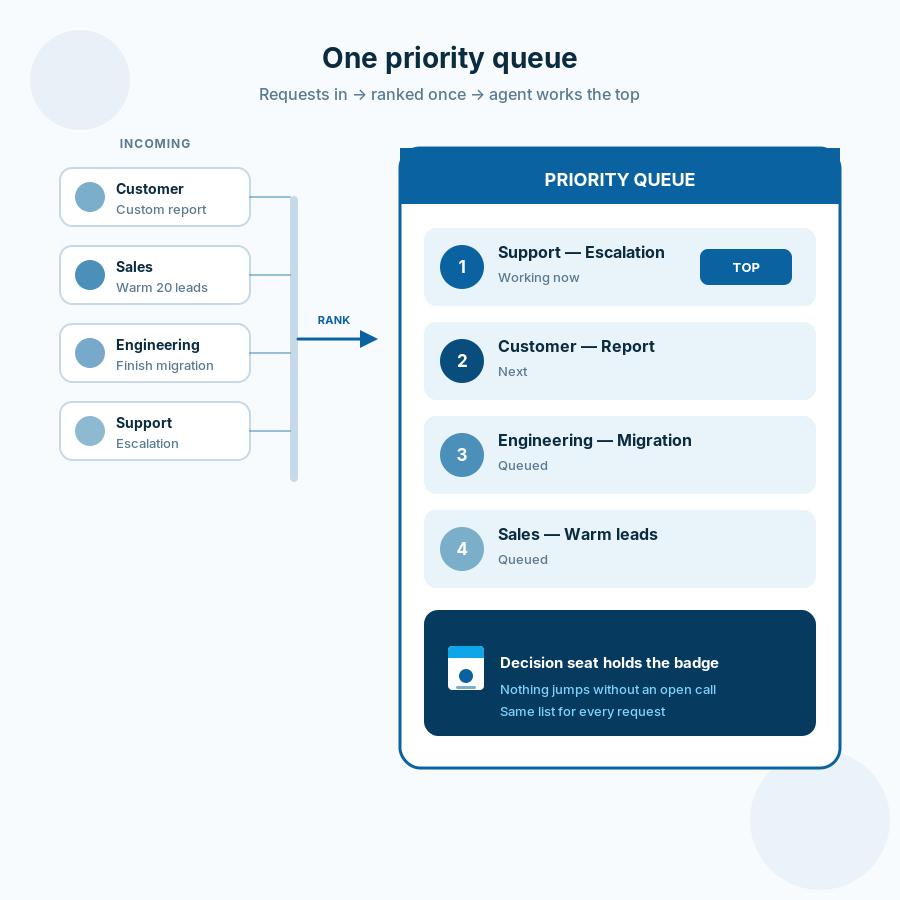
Founders tend to push back on this as bureaucracy. In practice, it's what ends the 11:47 p.m. thread. Instead of three people arguing in Slack, the owner checks the list: the customer report is priority 1 because it's tied to a renewal, the leads are 2, and the migration waits until morning. That takes about a minute.
Without the queue, whoever posts last wins. The customer who never complains is usually the one who quietly leaves.
3. Tell Customers What the Agent Actually Does
Customers hear "we use AI agents" and imagine instant, unlimited capacity. You know the agent is a limited resource that gets interrupted, needs context, and still needs a person to review its work before it ships.
Close that gap before the first demo. Tell customers three things during onboarding: what the agent handles end to end, what still goes through a person, and how long things take when the queue is busy. For example: "The agent drafts your weekly report within 4 business hours. A person reviews it before it goes out. During a launch week, plan on next-day delivery."
That sentence costs you nothing in a sales call. It saves you an awkward email on the first Friday you miss.
4. Write the SLA Before You Add More Agents
An SLA, or service level agreement, is a short written promise about what you deliver and how fast. If you can't fit yours for your agents on one page, you're not ready to put more of them in front of customers.
Keep it to four questions:
- Which jobs does the agent guarantee to finish?
- How fast, under normal load?
- When does a person take over?
- What happens when two "urgent" requests land at once?
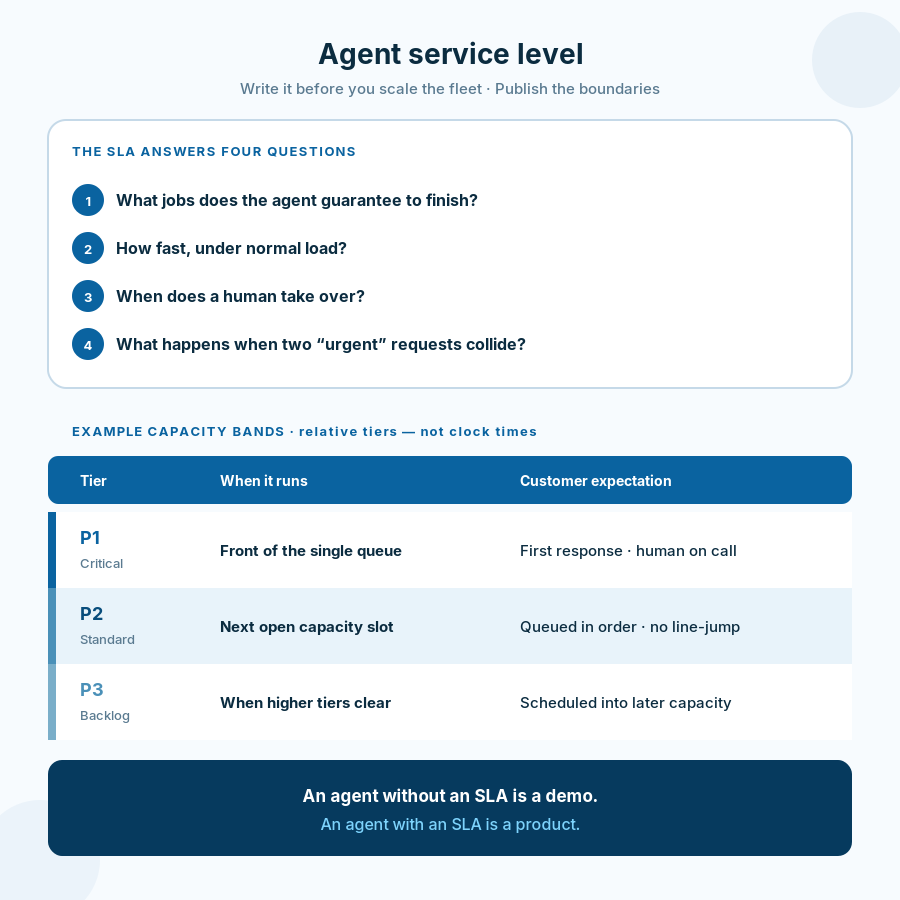
Keep it next to the queue. Update it when the numbers change, for example when review time moves from 4 hours to 8 because you added a second customer tier. Sales and support should quote from the same page, so a customer never hears two different turnaround times from the same company.
5. Back the Owner When They Say No
Naming an owner only works if the rest of the company respects their calls. That includes the founders.
So nobody reassigns the agent in the middle of a sprint without asking. Customer promises go through the queue, not around it. And "we'll fit that into next week" counts as a real answer. When sales promises a prospect a custom analysis by Thursday, the request goes to the owner first, not straight to the agent.
Agents usually don't fail because the model is weak. They fail because nobody decided who directs them.
This week, pick the owner, set up the queue, and write the one-page SLA while you still have few enough agents to keep track of. Then tell your customers what it says.
28th October 2026