


Your demo is not ready until someone who actually does the job has used it on messy work. Early-stage founders building in a domain they do not work in should get that person into the loop before they call the product done.
Say a founder spent weeks on a billing tool for small clinics. The demo was clean: an invoice went in, a claim went out, and the status turned green. Investors liked it. In week one at a real clinic, a claim came back with a two-payer split the demo had never shown, the status sat on "pending" with no next step, and the billing manager stopped trusting the tool by Thursday. Anyone who had done that job would have asked about split bills in the first conversation.
Tourists can hold a good map and still get lost. Locals know which bridge is out. AI makes it easier than it used to be to ship a convincing first version in someone else's domain. It does not give you judgment about which edge cases cause a customer to walk away. You need a local guide early: a person who does the work every day.
1. A Good Map Isn't Local Knowledge
Demos mislead you because you choose the path. You pick the happy case, the invoice with every field already filled in. The person who does this all day lives in the exceptions, like a claim that comes back twice.

A straight map line is blocked by a dig site and the broken bridge. The guide's route winds around both.
In the hypothetical, the map was accurate for the one road it showed. It said nothing about the bridge that was out. A good demo can win a meeting. It cannot tell you whether the product will survive the first ugly week.
2. Find Your Local Guide
Who qualifies: someone who currently does the job, or did it recently enough that the ugly cases are still in their hands. A consultant who talks about the industry is not enough. A friend who knows a lot of people in healthcare is not enough. You want the person who has been stuck on a split bill late on a Friday.
Where to find them: offer to pay for a few hours. Trade a useful manual workaround. Ask in places those people already spend time. The FounderCloud community is one place to start if you need an introduction to someone who works in the domain.
Be specific about the ask: two hours, three messy workflows, and permission to watch them hesitate. Pay them. If you cannot pay cash, make the trade clear and fair. Do not dress it up as a partnership when you mean a short working session.
3. Run the Three Messy Cases Test
Before you call the product ready, have that person walk through three ugly, real workflows, not the happy path you use in demos.
How to pick the cases: ask the guide for three jobs from the last month that went wrong or ran late. In a clinic billing setting, that might be a split-payer claim or a rejected code that had to be resent. Let the guide choose. Your clean example should not be one of the three.
Watch what they do, not what they say they like. Write down every hesitation, including the pause at a field or the moment they reach for a spreadsheet they still trust more than your screen.
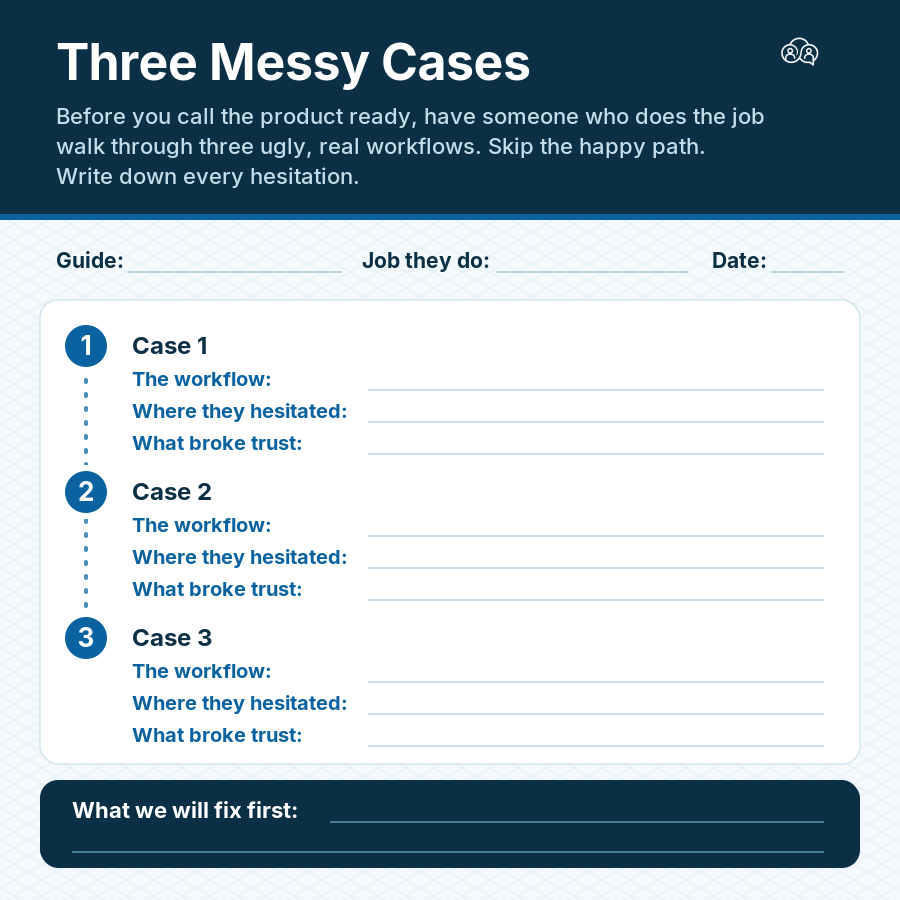
Have someone who does the job walk through three ugly, real workflows, and write down every hesitation.
A case fails if they cannot finish it, or if they finish it but would not trust the output enough to send it on. That second failure is the one founders miss. The tool ran to the end, and the local guide still would not stake their name on it.
4. Keep the Guide on the Trail
One session is not a substitute for judgment. Keep a standing check-in, even if it is thirty minutes every other week. Give the guide a short brief: what you currently think the job is, and where you want to be proven wrong. Ask them to bring one new messy case each time.
In our hypothetical, a one-page brief might say: "I think the job is getting a claim from the visit to the payer with a status the billing manager can act on. Please show me where that is wrong, especially on split payments and rejected codes."
When the product changes, run the three messy cases again. The guide should stay close enough to catch the next closed bridge before a real customer finds it.
This week, find one person who does the job and book the Three Messy Cases test. If you do not already know that person, start asking for an introduction now.
Pocket checklist:
- Name the job in one sentence, as you understand it today.
- Find a person who currently does that job, and pay or trade fairly for a short session.
- Have them walk through three ugly cases from their real work.
- Write down every hesitation, and every place trust broke.
- Leave them a brief: what you think the job is, and where you want to be proven wrong. Set the next check-in.
Book that session before your next investor demo.
13th November 2026