


The Omakase Startup: Why "Taste" is Your Only Defense When Code is Free
We have reached the inflection point. Generative AI models, autonomous coding agents, and tools like GitHub Copilot have driven the marginal cost of creating software to near-zero.
Three years ago, a complex B2B SaaS platform required a team of ten senior engineers, millions in venture capital, and eighteen months of runway to build. Today, a single "10x Orchestrator" can generate, test, and deploy that exact same feature set in a weekend.
If code is free, then software features are infinitely abundant. And the basic law of economics dictates that when supply becomes infinite, the price plummets to zero.
You can no longer compete on having more features. You cannot compete on having a faster roadmap. The "All-in-One Platform"—the software buffet—has become a commodity.
To survive and command a premium in 2026, founders must embrace the Omakase Moat. You must stop acting like a software engineer, and start acting like a master chef.
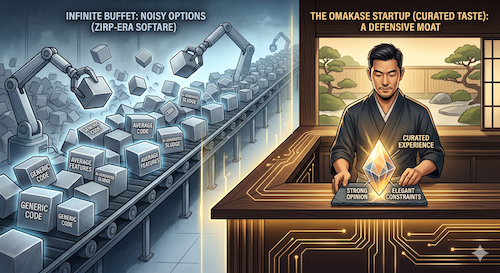
1. The Buffet vs. The Master Chef
If you go to a cheap, all-you-can-eat buffet, you are overwhelmed by choice. There are 100 different dishes, all of average quality. You are burdened with the cognitive load of deciding what to eat, how to pair it, and what to avoid. It is cheap, filling, and entirely forgettable.
Compare this to a high-end Omakase sushi restaurant. "Omakase" translates to "I leave it up to you."
When you sit at an Omakase counter, there is no menu. You surrender your choice entirely to the chef. You are paying a massive premium—not for the volume of food, but for the chef's Taste. You are paying for their curation, their sequencing, their specific sourcing, and their distinct point of view. You are paying for the luxury of not having to make a decision.
Most B2B SaaS companies are buffets. They have 50 navigation tabs, 400 customizable settings, and a dashboard that looks like an airplane cockpit. They force the user to figure out how to use the tool.
The Omakase Startup takes the exact opposite approach.
2. Taste as a Defensible Asset
In a world where AI can generate any feature instantly, Taste is the only thing that cannot be automated.
AI models are trained on the vast corpus of the internet. By definition, they optimize for the median. They output the consensus average. They are inherently generic.
Taste is highly opinionated. Taste is contrarian. Taste means saying, "We could build a custom dashboard builder with 50 widgets, but we aren't going to. We have analyzed the data, and there are only three metrics that actually matter for your business. We are only showing you those three. If you want a custom dashboard, go use our competitor."
When you build an Omakase Startup, you embed your specific, expert point of view directly into the product's constraints. You don't give the user a sandbox; you give them a perfectly curated, frictionless path from A to B.
3. The Premium of Constraints
Founders are terrified of removing features because they think it makes their product less valuable. In reality, the ultimate luxury in 2026 is cognitive relief.
Enterprise workers are drowning in decision fatigue. They are managing human teams, auditing AI agents, and navigating a chaotic macroeconomic climate. When they open your software, they don't want a toolkit; they want an answer.
Every time you add a configuration setting, you are pushing work back onto the user. Every time you remove a setting and hardcode an elegant default based on your deep industry expertise, you are delivering value.
Customers will pay a premium for constraints. They will pay 5x the market rate for a tool that forces their team to follow a perfect, highly opinionated workflow, because it saves them the time of having to design that workflow themselves.
4. The Shift: From Engineer to Editor
This reality requires a profound shift in the founder's identity.
For a decade, the hero of Silicon Valley was the builder—the engineer who could stay up for 48 hours writing brilliant code.
Today, the hero is the Editor.
The Editor does not write every word; they cut away the excess until only the perfect narrative remains. As a founder, your AI agents will generate a mountain of code, a hundred potential features, and a dozen different user interfaces.
Your job is not to ship them all. Your job is to aggressively, ruthlessly edit them down to the absolute essential. You must be the uncompromising gatekeeper of the user experience.
Surrender to the Chef
If you try to build an "all-in-one" platform today, you are competing against an infinite army of autonomous coding agents that will out-build you by tomorrow morning. You will drown in the buffet.
Your only defense is to narrow your focus, develop a radical, opinionated point of view on how your customers should work, and build software that forces them into that elegant path.
Stop asking your users what they want. Tell them to sit down, surrender their choices, and trust the chef.
1st June 2026