


The Solo Founder Tax: What Building Alone Actually Costs You
Picture this: It’s 11:30 PM on a Thursday. You’ve been staring at a stagnant user growth chart for an hour. Suddenly, a realization hits you—the problem is your pricing model. So, fueled by caffeine and a surge of midnight conviction, you tear down your freemium tier, rewrite the Stripe integration, alter the landing page copy, and push to production by 3:00 AM.
You feel like a 10x builder. You are moving fast.
Two weeks later, churn spikes by 40% and top-of-funnel conversions flatline.
If someone else had been sitting across the desk from you that Thursday night, they would have looked at your screen and said, "Are you crazy? Our freemium funnel isn't the problem, our onboarding sequence is."
But there was no one across the desk. You were alone. You executed flawlessly on a fatally flawed premise.
The prevailing myth in Silicon Valley is that solo founders fail because they lack technical skills, or because they simply run out of bandwidth to do all the work. That is a lie. Solo founders don't fail from a lack of skill or capacity.
They fail from a lack of friction. Building in a vacuum creates a silent, compounding debt. It’s a hidden levy on your startup's potential, and I call it The Solo Founder Tax.
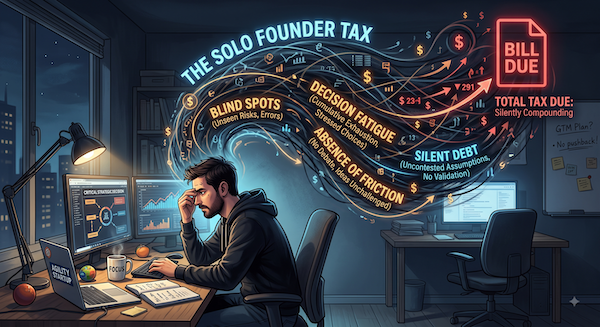
This tax primarily manifests in three insidious ways:
1. The Decision Fatigue Spiral
When you are alone, you are the final arbiter of every single input. You have to decide the architecture of the database, the tone of the outbound marketing emails, the Series A valuation cap, and the hex code of the "Submit" button. Human willpower is finite. When a solo founder is forced to make 500 decisions a day, the quality of decision #501 drops to zero. You start choosing the easiest path, not the right one, simply because you are exhausted.
2. The Blind Spot Penalty
You only know what you know, and your instincts only lean in one direction. If you are a brilliant, introverted engineer, your natural instinct is to solve a growth problem by writing more code, completely blind to the fact that you just need to pick up the phone and call ten customers. Without a counterbalance, you will continually drive the car into your own blind spot.
3. The Absence of Forced Clarity
This is the most expensive form of the tax. When you have a co-founder, you cannot simply execute on a "gut feeling." You are forced to articulate your half-baked ideas, out loud, to an intelligent equal who will push back. Having to explain the why behind your strategy forces you to crystallize fuzzy logic. When you build alone, you never have to justify your logic to anyone but yourself—and you are the easiest person in the world to fool.
The data backs up the intuition. When First Round Capital analyzed a decade of their investments, the numbers were brutal: teams with co-founders outperformed solo founders by a massive 163%. Y Combinator historically funds teams over solo founders at an overwhelming ratio—not because two people write code twice as fast, but because two people catch each other's fatal errors.
Now, I can hear the immediate counterargument: "But a bad co-founder is worse than no co-founder! I've seen toxic partnerships destroy great companies!"
You are absolutely right. A misaligned co-founder is a company-killer. It is the equivalent of strapping a cinderblock to your ankles before jumping into the deep end.
But choosing to swim alone in the middle of the ocean because you are afraid of a bad lifejacket is a false dichotomy. The fear of a bad partner should not resign you to paying the Solo Tax.
Ultimately, finding a co-founder isn't about halving your workload. It is about deliberately engineering the right friction. You need an intellectual sparring partner. You need an adversary who is deeply aligned with your mission, whose natural instincts cover your vulnerabilities, and who will grab the keyboard from you at 11:30 PM on a Thursday and say, "No."
Stop paying the tax. Find your friction.
13th August 2026