

Two Orchestrators, Zero Employees: The High-Stakes Reality of the AI Startup
The 36-Month Pop-Up thesis fundamentally rewrites the rules of company building. When your goal is to build, scale, and exit an AI-native product within three years, the traditional startup playbook—raising bloated seed rounds to hire armies of specialized middle managers—becomes a massive liability.
In this new paradigm, the ideal startup size is not fifty, twenty, or even ten people. It is two or three.
But when a company consists of only two human beings, those two people can no longer be traditional founders who manage teams. They must be orchestrators. And because there are no employees to act as shock absorbers, who you choose as your co-orchestrator becomes the single highest-stakes decision in the lifespan of the company.
The Shift from Managers to Orchestrators A traditional founder builds a company by building a team. An orchestrator builds a company by building systems.
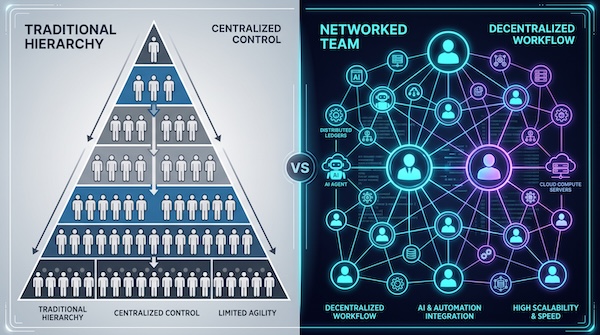
In the past, when a non-technical founder needed a massive dataset analyzed to rate startup idea entries, they hired a data analyst or an offshore engineering firm. Today, an orchestrator simply fires up Cursor, writes a Python script leveraging the Gemini API, and automates the entire text analysis pipeline before lunch.
Orchestrators do not delegate to junior staff; they delegate to AI agents, automated workflows, and highly leveraged SaaS tools. Every function that used to require a W-2 employee—copywriting, QA testing, frontend boilerplate, lead generation—is now managed from a single dashboard.
This means the two humans at the top are not managing people. They are directing compute.
The Amplified Risk of Co-Founder Selection
When you only have two orchestrators and zero employees, the margin for error in co-founder selection drops to zero.
In a traditional fifty-person startup, a weak co-founder relationship can be temporarily masked. VPs can bridge the gap, middle managers can keep execution moving, and momentum can carry a fractured leadership team for years.
In a two-person Pop-Up, there is nowhere to hide. If one orchestrator loses focus, output doesn't drop by ten percent; it drops by half. If the two orchestrators are fundamentally misaligned on product vision, the entire company ceases to move.
"Two orchestrators" is a delicate, high-wire balancing act. It requires absolute trust, extreme technical or operational competence, and a shared commitment to the 36-month timeline.
The Two Archetypes You Need
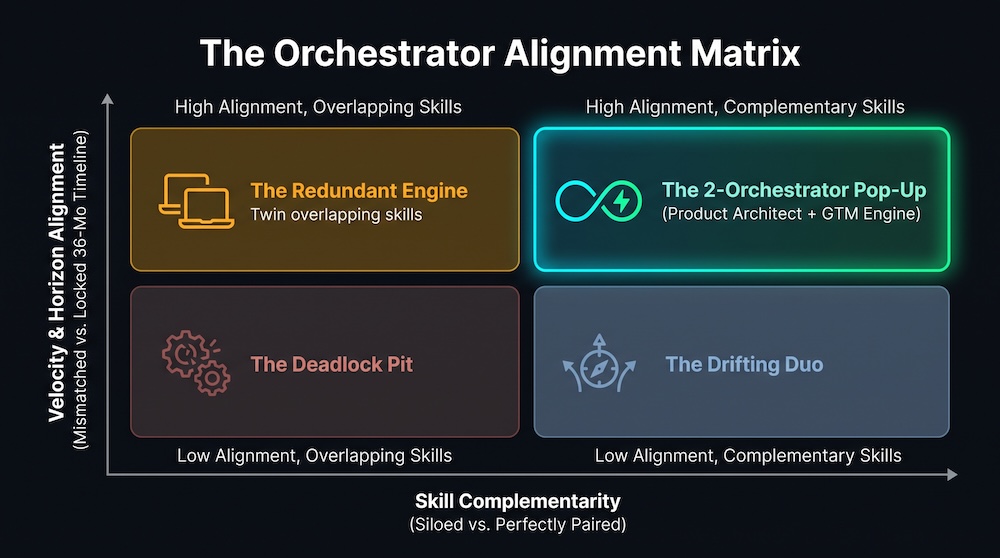
To execute a zero-employee Pop-Up successfully, the two orchestrators must possess completely complementary skills, with zero overlap in ego. You need two distinct archetypes:
The Product/AI Architect
This is not a traditional CTO who manages Jira tickets and code reviews. This is an individual contributor with God-level leverage. They understand how to string together foundational models, spin up serverless infrastructure, and push code at a velocity that would previously require a team of eight. They are ruthless about avoiding technical debt because they know they are the only one maintaining the system.
The GTM/Distribution Engine
This is not a traditional VP of Sales who builds cold-calling teams. This is a one-person media company and growth hacker. They automate outbound sequencing, build community flywheels, scrape lead databases, and generate high-converting copy using AI. They know exactly how to find the wedge in the market and distribute the product natively across every digital channel.
The Zero-Employee Operating System
Operating this way requires a radical shift in how you work together.
First, you must eliminate asynchronous blocking. When there are only two of you, waiting twenty-four hours for a Slack reply on a staging environment kills the model. You must operate with synchronous bursts of high-intensity collaboration, followed by deep, uninterrupted focus.
Second, you must kill the concept of internal meetings. You do not need a weekly all-hands. You need a shared Notion board, a single source of truth for the codebase, and a relentless focus on shipping.
Third, you must apply the same ruthless equity frameworks we discussed previously. A dynamic equity split or a strictly vesting fixed split is even more critical when the entire company's value is generated by just two keyboards.
The 36-Month Pop-Up model is the most efficient wealth-creation vehicle in the modern economy. But it requires abandoning the vanity metrics of headcount and office space. It demands that you stop being a manager and start being an orchestrator. Choose your partner wisely.
3rd September 2026